Hip Replacement Surgeon in Pune, PCMC – Dr. Swaroop Solunke
Hip arthritis rarely announces itself as hip pain first. More often it shows up as a dull ache in the groin or thigh, a limp that's crept in gradually, or the realisation that putting on socks and shoes has quietly become difficult. By the time walking distance has shrunk and the pain interrupts sleep, physiotherapy and medication are usually no longer enough — and that's the point at which it's worth seeing a surgeon who does this specific operation often, not occasionally.
Dr. Swaroop Solunke is a hip replacement surgeon in Pune, fellowship-trained in hip and knee arthroplasty at St. Josef Hospital, Paderborn, Germany, and in robotic joint replacement at the Stone Research Foundation, San Francisco. He performs conventional, robotic-assisted, revision and bilateral total hip replacement from clinics in Wakad and Nigdi-Pradhikaran, and has completed 2,500+ joint replacement and trauma surgeries across Pune and PCMC.
Signs You May Be Ready for Hip Replacement
Not every hip ache needs surgery, but a few patterns are worth flagging to your doctor rather than waiting out:
- Groin or thigh pain — often the earliest sign of hip joint damage, even before pain is felt at the hip itself
- A limp that has developed gradually or worsened over recent months
- Difficulty putting on socks or shoes, or getting up from a low chair or the floor
- Pain that wakes you at night or doesn't settle with rest
- A noticeably shrinking walking distance, or leaning on furniture or a stick to get around
- X-rays showing joint space narrowing, bone spurs, or avascular necrosis
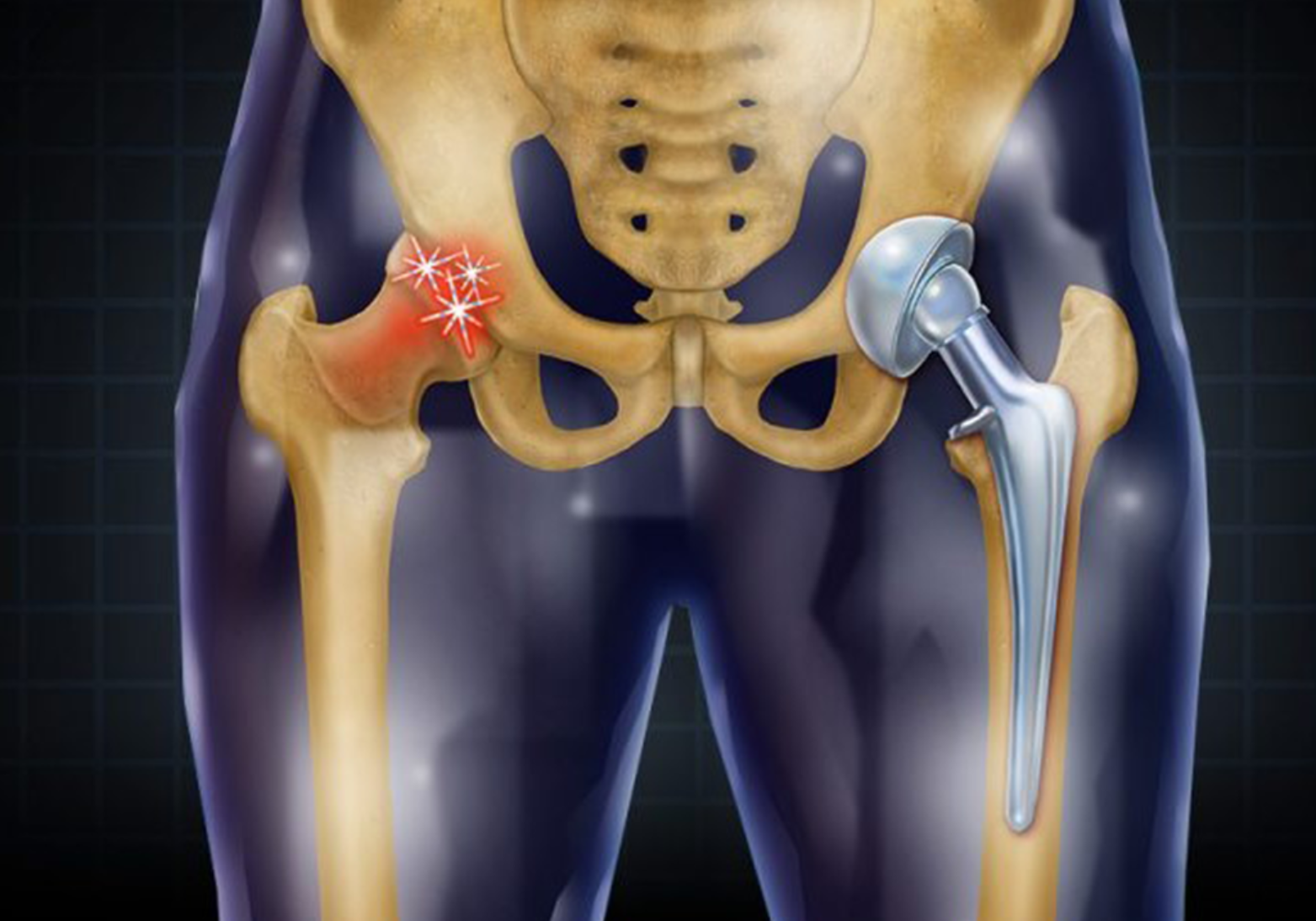
Meet Dr. Swaroop Solunke – Hip replacement Surgeon in pune
Dr. Swaroop Solunke has spent 16 years in clinical practice, the last 11 focused specifically on orthopedics and joint replacement. His MS in Orthopaedics from MGM Medical College was awarded with a gold medal, and he went on to train internationally in both hip and knee reconstruction — a fellowship in hip and knee arthroplasty at St. Josef Hospital in Paderborn, Germany, followed by a fellowship in robotic knee replacement at the Stone Research Foundation in San Francisco. That combination of European arthroplasty training and US robotic experience is uncommon among orthopedic surgeons practising in Pune, and he has performed more than 2,500 joint replacement and trauma surgeries to date.
What to Look for in the Hip Replacement Surgeon in Pune
Patients researching this usually end up weighing the same handful of things — surgical volume, whether the surgeon provide robotic as well as conventional technique, whether they'll take on a revision if something goes wrong later, and how easy follow-up care will be logistically. Here's how that maps onto this practice:
| What Patients Look For | Why It Matters | At This Practice |
|---|---|---|
| Surgical volume | Higher case volume is generally linked to fewer complications | 2,500+ joint replacement & trauma surgeries |
| Fellowship training | Formal training beyond an MS signals depth in a specific technique | Hip & knee arthroplasty (Germany) + robotic replacement (USA) |
| Revision capability | Not every surgeon is equipped to redo a failed implant | Revision and bilateral hip replacement service |
| Local follow-up access | Recovery visits are easier close to home | Clinics in Wakad & Nigdi-Pradhikaran; GBP listings across 5 areas |
Hip Conditions & the Procedures Used to Treat Them
| Condition | Typical Procedure |
|---|---|
| Advanced osteoarthritis of the hip | Total hip replacement — conventional or robotic-assisted |
| Avascular necrosis of the femoral head | Total hip replacement, often robotic-assisted for precise implant sizing |
| Hip fracture (elderly or trauma-related) | Hemiarthroplasty or total hip replacement, depending on fracture pattern |
| Failed or worn previous hip implant | Revision hip replacement |
| Arthritis affecting both hips | Bilateral hip replacement, staged or in a single admission |
Surgical Approach: What's the Difference?
Hip replacement can be done through more than one surgical approach, and it's a fair question to ask before surgery. The posterior approach is the most widely used technique and gives the surgeon excellent visibility of the joint, though it typically involves a period of movement precautions afterward — avoiding deep hip bending, crossing the legs, or twisting the hip inward — while the surrounding tissue heals. The anterior approach works through the front of the hip, between rather than through the muscle planes, which for suitable patients can mean fewer post-operative movement restrictions, though not every hip is anatomically suited to it.

Robotic-Assisted Hip Replacement
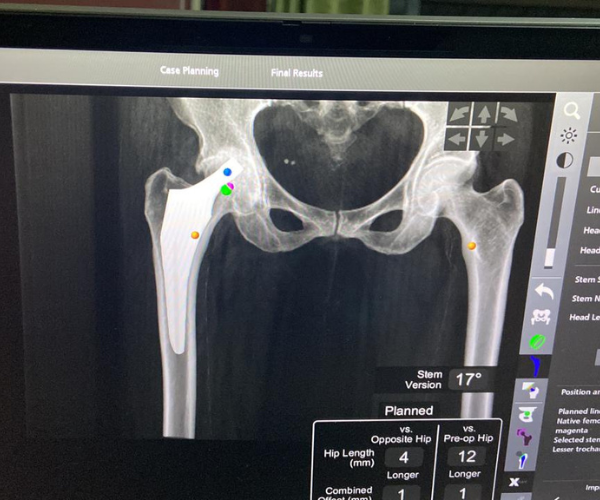
For hip replacement specifically, robotic assistance is used mainly to improve two things patients notice most after surgery: cup positioning and leg-length accuracy. The system maps the pelvis and femur before surgery and helps guide implant placement within the planned position, which supports better hip stability and a more even leg length than freehand instrumentation alone tends to achieve. Dr. Solunke trained in this technique during his US fellowship and applies it selectively, based on the individual hip and case.
Cost of Hip Replacement in Pune
Pricing depends on whether the procedure is unilateral or bilateral, conventional or robotic-assisted, which implant is used, and how long the hospital stay runs — a straightforward cemented conventional hip replacement typically costs less than a robotic-assisted or revision procedure. Dr. Swaroop's Ortho & Polyclinic is positioned as an accessible, mid-range option in Pune rather than a premium corporate-hospital rate.
Recovery After Hip Replacement
Hip replacement recovery often moves faster than knee replacement in the first few weeks — the hip isn't a hinge joint absorbing the same repetitive bending load, so many patients are walking with a walker within 24 hours of surgery and off it within two to four weeks. The early precautions are mostly about movement rather than pain: avoiding low chairs, deep bending and crossing the legs for the first several weeks (fewer restrictions with an anterior approach), while structured physiotherapy rebuilds hip strength and a normal walking pattern. Most patients are back to most daily activities within six to eight weeks.
Clinic Locations
| Clinic | Area | Role |
|---|---|---|
| Dr. Swaroop's Ortho & Polyclinic | Wakad, Pune | Consultation & surgery |
| Joint Aura Ortho and Polyclinic | Nigdi-Pradhikaran, PCMC | Consultation & surgery |
GBP listings are also maintained for Hinjewadi, Aundh, Pimple Saudagar and Shivajinagar, covering patients across Baner, Pimpri and central Pune who travel in for consultation.
Before Your First Hip Consultation
- Any hip or pelvis X-rays, MRI or CT scans, plus the accompanying reports
- A record of past hip injections, physiotherapy, or medication already tried
- Notes on when the limp or pain started and what tends to make it worse
- The footwear you normally walk in — it helps the surgeon assess your gait
- Insurance or cashless-approval documents, if applicable
- Your own questions — surgical approach, expected recovery, cost
- Someone to accompany you if walking or standing for long is difficult